UC IM Weekly Newsletter ͏ ͏ ͏ ͏ ͏ ͏ ͏ ͏ ͏ ͏ ͏ ͏ ͏ ͏ ͏ ͏ ͏ ͏ ͏ ͏ ͏ ͏ ͏ ͏ ͏ ͏ ͏ ͏ ͏ ͏ ͏ ͏ ͏ ͏ ͏ ͏ ͏ ͏ ͏ ͏ ͏ ͏ ͏ ͏ ͏ ͏ ͏ ͏ ͏ ͏ ͏ ͏ ͏ ͏ ͏ ͏ ͏ ͏ ͏ ͏ ͏ ͏ ͏ ͏ ͏ ͏ ͏ ͏ ͏ ͏ ͏ ͏ ͏ ͏ ͏ ͏ ͏ ͏ ͏ ͏ ͏ ͏ ͏ ͏ ͏ ͏ ͏ ͏ ͏ ͏ ͏ ͏ ͏ ͏ ͏ ͏ ͏ ͏ ͏ ͏ ͏ ͏ ͏ ͏ ͏ ͏ ͏ ͏ ͏ ͏ ͏ ͏ ͏ ͏ ͏ ͏ ͏ ͏ ͏ ͏ ͏ ͏ ͏ ͏ ͏ ͏ ͏ ͏ ͏ ͏ ͏ ͏ ͏ ͏ ͏ ͏ ͏ ͏ ͏ ͏ ͏ ͏ ͏ ͏ ͏ ͏ ͏ ͏ ͏ ͏ ͏ ͏ ͏ ͏ ͏ ͏ ͏ ͏ ͏ ͏ ͏ ͏ ͏ ͏ ͏ ͏ ͏ ͏ ͏ ͏ ͏ ͏ ͏ ͏ ͏ ͏ ͏ ͏ ͏ ͏ ͏ ͏ ͏ ͏ ͏ ͏ ͏ ͏ ͏ ͏ ͏ ͏ ͏ ͏ ͏ ͏ ͏ ͏ ͏ ͏ ͏ ͏ ͏ ͏ ͏ ͏ ͏ ͏ ͏ ͏ ͏ ͏ ͏ ͏ ͏ ͏ ͏ ͏ ͏ ͏ ͏ ͏ ͏ ͏ ͏ ͏ ͏ ͏ ͏ ͏ ͏ ͏ ͏ ͏ ͏ ͏ ͏ ͏ ͏ ͏ ͏ ͏ ͏ ͏ ͏ ͏ ͏ ͏ ͏ ͏ ͏ ͏ ͏ ͏ ͏

University of Cincinnati Internal Medicine

Announcements!

Primary Care Pathway: A new Primary Care Pathway (spearheaded by the wonderful Bill Jessee and Mati Segev) is in the works with the goal to augment our program's primary care exposure and education throughout residency through educational sessions on important knowledge fields and skill sets within primary care, having priority pick for ambulatory electives throughout residency, and increased mentorship and networking in the PCP community, among other super cool opportunities!

Our first session will be Monday 9/15 at 5PM with Dr. Warm giving an incredible talk on Motivational Interviewing. All are welcome, even if you do not plan to pursue primary care/the Primary Care Pathway. If interested in joining the pathway, please fill out the interest form

Global Health Pathway: Interested in Global Health? Sign up for the Global Health Pathway!! You can join the GHP mailing list and fill out the application in Liz/Dr. Stickles’ email by September 15th to apply!

New HTN guidelines dropped! Check them out in detail here. We now aim to use the PREVENT calculator (instead of ASCVD). Guidelines also clarify severe HTN (>180/120) without end-organ damage should be treated outpatient!

PLEASE sign up for AHD as preceptors! We’ve updated the sign-up sheet with the topics, come through for amazing teaching and learning opportunities!

The ACC is now accepting applications for all cohorts in ACC’s Internal Medicine Cardiology Program. This is a unique program designed to introduce participants to a career in cardiology. Applications are now open through September 14 for residents in good standing in their program, member of an underrepresented in Cardiology community (women, African American/Black, Hispanic/Latinx, LGBTQ+, or Indigenous People) and a Medical Resident member of ACC. Click here to apply!

Registration is now open for the 4th Annual Women’s Cardiovascular Symposium (so much Cards goodies in this Scoop!) that will be held at the Summit Hotel on Friday, October 3rd. Click here to register

Wards Updates

VA Updates:

VA is expanding the diagnoses that IM-led stepdown level of care can take - any cardiac case that is HDS, not on a titratable drip, or in cardiogenic shock/needing invasive monitoring (pacing, swan, etc) can be admitted to medicine for stepdown!

VA ED will now primarily handle triaging to appropriate level of care (medicine, ICU, etc) prior to calling up for admission. Barring safety concerns or service availability (NSGY, CTS, etc), expectation will be to accept the patients assigned by the ED. Discuss with ED if there is safety concern.

New VA alcohol withdrawal order set in place! Co-created with pharmacy and detox, it’s better and more standardized - found in the same place as before (Inpatient Medications, second to R column).

UC Updates:

Use the in-person interpreter services for Spanish/ASL - call 513-476-5682, especially for in-depth, complex, or difficult conversations (from M-F 7a-11p).

Methadone at Discharge: we can dispense 72hr methadone for patients to bridge to their methadone clinic visit (when discharging on weekends/holidays)! Page Addiction team M-F to facilitate!

*******PLEASE REVIEW THE BELOW UPDATES ON BEDFLOW. Previous requests that went through the Chiefs now go through the AOD consult attending due to these changes. Save these process maps on your phone for review!

ABIM Question

A 21-year-old woman with type 1 diabetes mellitus is evaluated in the emergency department for diabetic ketoacidosis. She uses an insulin pump.

On physical examination, blood pressure is 100/60 mm Hg, pulse rate is 110/min, respiration rate is 20/min, and oxygen saturation is 98% with the patient breathing ambient air. Her mucous membranes are dry, and she has mild abdominal discomfort to palpation. Other than tachycardia, the remainder of the physical examination is normal.

Na 138 | K 3.2 | CO2 10 | Phos 3 | Gluc 500 | AG 22 | BHB elev | pH 7.2

Fluid resuscitation with 0.9% saline is initiated.

Which of the following is the most appropriate intravenous treatment?

A) Insulin

B) Phosphorus

C) Potassium chloride

D0 Sodium bicarbonate

Answer at the bottom!

Upcoming Education

UC

Monday: Happy Labor Day!

Tuesday: Neuro - Strokes/AC/Anti-platelet w/ Chris Shin (3051)

Wednesday: MGR

Thursday: AHD - Coagulation//Weesner - Complex Care (4352)

Friday: Medical Education Pathway with Dr. Kinnear (3051)

VA

Monday: Happy Labor Day!

Tuesday: TBD

Wednesday: MGR

Thursday: AHD - Coagulation

Friday: VA Town Hall

Resident Photos

Intern GNO!!!

Commence the photo series from Sarah’s beautiful wedding! Starting with this dysfunctional family pic

~Elevating~ the selfie game

Just stunning <3

Naveen harboring secret desires to be back in residency no doubt

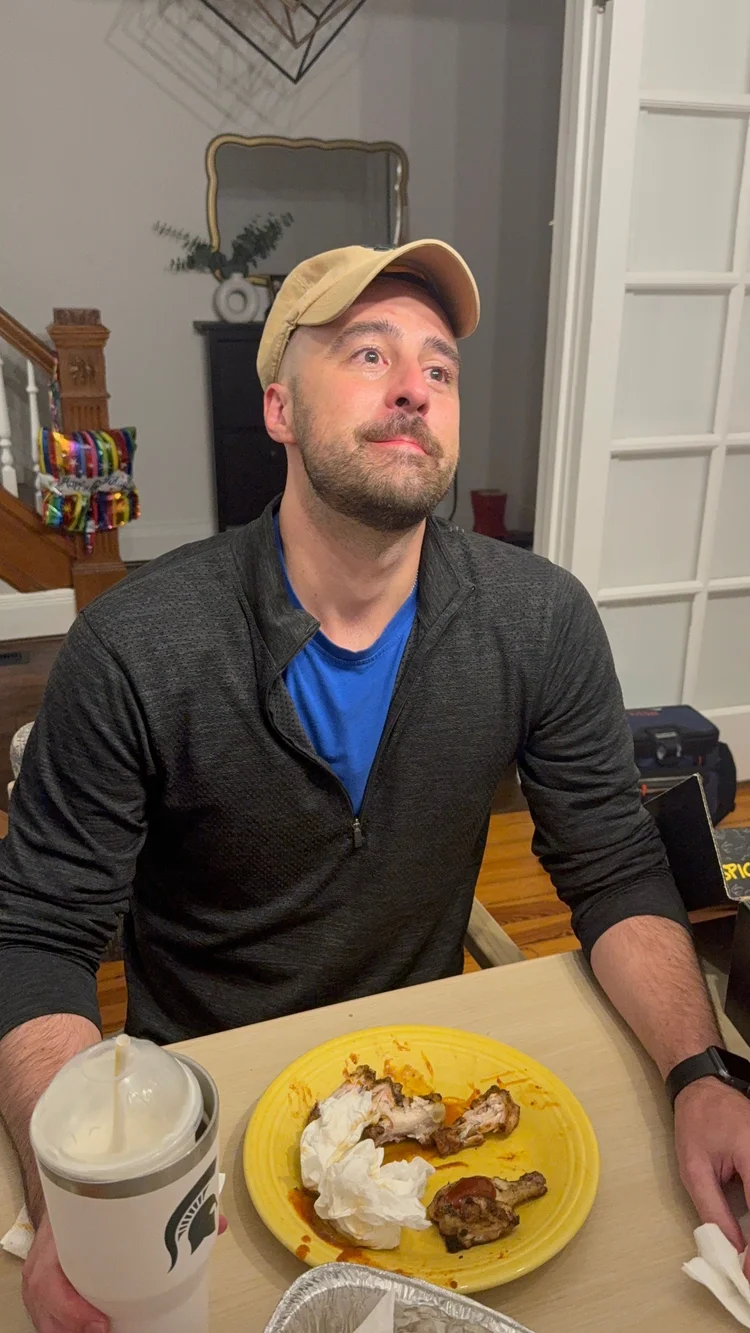
Hot ones challenge = 1, Blake = 0

Breakfast for Dinner at Lindsey’s!!!

Fancy Friday in full swing!

catch your chiefs in our glowing post-boards era!!!

Shout Outs!

To Nathaniel Snyder for doing a phenomenal job in the MICU - his attendings shouted out his amazing work ethic, his excellent clinical reasoning, and his thorough patient care! A role model!

To Green Team, especially Ben Dreskin and David Karngba, for running the team without a senior for multiple days and absolutely crushing it! We are inspired by your hard work!

To Kenzo for being an amazing senior on Blue Team, navigating difficult cases, providing excellent teaching, and motivating and pushing all the learners to be their best!

To Trevor for deftly dealing with a very complicated situation with a suprapubic catheter and for being the king of Foleys at the VA!

To Lauren Petersen for being a dear friend

To Jordan Pennington for being an amazing human and friend!

To Brandon and Danielle for being ice cream partners in crime

To Blake for surviving the Hot Ones challenge (editorial note: I think the tears would say otherwise)

To Sophia Tunny for being a kicka** resource senior!

To Trevor Stantliff for an incredible VA Noon Report case!

Answer:

The most appropriate next step is to administer KCl (Option C), 10 to 20 mEq/L/h (10-20 mmol/L/h), until the serum K level is greater than 3.5 mEq/L (3.5 mmol/L); then 10 to 20 mEq/L (10-20 mmol/L) of K can be added to each liter of saline thereafter. Glucosuria in DKA causes an osmotic diuresis and severe volume depletion, which may progress to lethargy, obtundation, and death if the hyperglycemia, dehydration, and electrolyte abnormalities are not treated aggressively and early. Aggressive intravenous volume replacement with 0.9% saline is indicated. Electrolyte deficits, such as K, should be replaced, and hyperglycemia should be corrected with intravenous insulin. In DKA, total body K levels are depleted because of shifts from the intracellular to extracellular space caused by the ketoacidosis and insufficient insulin. Potassium urinary losses are generated by the glucose osmotic diuresis and result in potassium depletion. Normal or low serum K levels indicate a depletion of body stores and require supplementation before insulin therapy is initiated.

Initiating insulin (Option A) before K replacement could cause life-threatening hypoK because insulin shifts potassium into the intracellular space. Therefore, K should be replaced to above 3.5 mEq/L (3.5 mmol/L) before initiating insulin.

Because DKA is often associated with hypophosphatemia, phosphorus levels (Option B) should be monitored. However, routine replacement of phosphorus is not indicated because no therapeutic benefit is evident, except in severe hypophosphatemia (<1 mg/dL [0.32 mmol/L]).

Sodium bicarbonate (Option D) is only considered in patients with severe acidosis (pH <7.0). Alkali therapy may prolong the recovery from DKA and may result in a residual metabolic alkalosis once DKA is resolved.

Ongoing Reminders

AHD signups - for PGY2+: please sign up to join us as preceptors for AHD!

Call Rooms - 7168 and 7170 (hallway towards MICU) - code is 3-1-5

Ultrasounds - 8E (8161) and 6NW (6419) - sign it out w/ HUC

Procedures/Paracentesis - check your certification on SilverFridge (Education > Procedure), guide on supplies, etc

Duty Hours - Weekly reminder! Have you done your duty hours this week? If not - stop and do them now! Just click here.

Mail - Please stop by Liz’s office in MSB once per month to pick up your mail!

VA Access - Please remember to remotely log on to CPRS once per month.

Mental Health Resources - Employee assistance program offers short-term therapy options, will see residents <72hr - call at 513-585-6100. Psychiatric services - 513-585-7754; Physician Support Line - 1-888-409-0141; Suicide and Crisis Lifeline - 988

 Submit Your Shout Outs here! 
 Anonymous Feedback 

University of Cincinnati Internal Medicine, 231 Albert Sabin Way PO Box 670557, Cincinnati, Ohio, United States

Powered by Squarespace

Unsubscribe